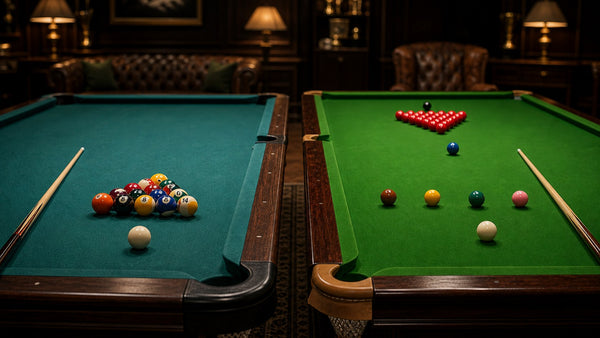
If someone tells you the white is “in the D”, it is easy to nod along and still not know what that actually changes. The D is one of the simplest markings on a snooker table, but it affects break-offs, restarts after the cue ball goes off the table, and the first angle you give yourself.
The short version: the D is the semicircle in the baulk area. It is where you place the cue ball when you are starting a frame or when you have cue ball in hand. The useful version is knowing where it is, what it allows, and what it does not allow.
What Is the D on a Snooker Table?
Quick answer: The D on a snooker table is the semicircle in the baulk area. It is drawn from the middle of the baulk line with an 11.5 inch (292 mm) radius. Players use it to place the cue ball for the break-off and when the cue ball is in hand.
On a full-size snooker table, the baulk line runs across the table near the end you break from. The D is drawn behind that line, towards the baulk cushion, with its straight edge sitting on the baulk line.
That means the D is not a pocket area, scoring area, or target. It is a legal placement zone for the white ball. The official rules define it as a semicircle in baulk with a radius of 11.5 inches, or 292 mm, from the middle of the baulk line.
Why the D exists
The D gives both players a consistent starting zone. Without it, every break-off or cue-ball-in-hand situation would need a new argument about where the white should go.
It also protects the character of the game. You get a choice of starting angle, but not a free licence to place the cue ball anywhere on the table. You still have to play from baulk, through distance, traffic and safety pressure.
Key point: The D gives you a controlled restart, not an advantage big enough to ignore the normal rules of the frame.
When do you use the D?
You use the D at the start of a frame for the break-off. The striker places the white in or on the lines of the D, then plays the opening shot.
You also use it when the incoming player has cue ball in hand, most commonly after the cue ball has gone off the table or into a pocket. In ordinary club language, people often say “white in hand from the D”.
The important detail is that your next shot still has to be legal. If a red is on, you must play a red first. If a colour is on, you must play the correct colour. The D only decides where the white starts from.
What the D does not let you do
- It does not make every ball playable. You still have to play the ball on.
- It does not let you place the white outside baulk. The cue ball must be in or on the D.
- It does not erase penalty points. Fouls are still scored separately.
- It is not the same as a free ball. A free ball is a separate rule after a foul when you are snookered on all legal balls.
This is where beginners often get caught. They understand that the white can be moved by hand, then assume the next shot is somehow easier by rule. It is not. The skill is choosing the best legal starting angle from a limited area.
How to choose where to put the cue ball in the D
Most beginners put the white near the centre of the D because it feels neutral. That is sometimes fine, but better players choose the spot that gives the cleanest first contact and the safest cue-ball route.
Use this quick decision process:
- Identify the ball on. Before moving the white, know exactly what you must hit first.
- Check the clearest line. Slide the white left or right in the D until the contact looks simpler.
- Think about the cue ball after contact. A legal hit is not enough if it sells the next chance.
- Avoid overusing power. If the position is poor, more pace usually makes the mistake louder.
For a break-off, players commonly use one side of the D to create a thinner contact on the pack and send the cue ball back towards baulk. For a restart after the white is potted, the best position depends on the next ball on and the available safety route.
Where are yellow, brown and green around the D?
The D also helps you understand three colour spots. Viewed from the baulk end looking up the table, green is on the left corner of the D, brown is in the middle of the baulk line, and yellow is on the right corner.
This orientation is a common source of confusion because televised snooker is often shown from the opposite end. If you are standing at the baulk cushion, use green, brown, yellow from left to right.
The official table markings are set out in the WPBSA rules, including the D radius, baulk line and colour spot positions.
Common beginner mistakes with the D
- Thinking the D is only for the break. It also matters when the cue ball is in hand.
- Placing the white automatically in the middle. The best angle might be closer to the yellow or green side.
- Forgetting the ball on. Cue-ball placement does not change the legal target.
- Confusing the D with baulk. Baulk is the whole area behind the baulk line; the D is the semicircle inside it.
- Using too much pace from the D. Many D shots reward clean contact and cue-ball control more than power.
A 10-minute D practice drill
If you want the rule to become useful, practise it as a placement decision rather than a definition.
- Place the white in the centre of the D and play a controlled break-off-style contact.
- Move the white towards the green side and repeat the same shot.
- Move the white towards the yellow side and repeat again.
- Compare which starting point gave the cleanest contact and safest cue-ball finish.
- Repeat with a simple safety target instead of a break-off contact.
After a few attempts, the D stops feeling like a fixed starting dot. It becomes a small decision zone where angle, pace and safety all meet.
Useful next steps
If you are learning table layout as well as rules, compare this with our guides to snooker balls, table accessories and snooker cues.
Bottom line
The D on a snooker table is the semicircle in baulk used for cue-ball placement at the break-off and when the cue ball is in hand. Its radius is 11.5 inches, with brown at the centre of the baulk line and yellow and green at the corners.
The rule is simple. The skill is choosing where inside the D gives you the best legal first contact and the safest cue-ball route.
FAQs
What does the D mean in snooker?
The D is the semicircle in the baulk area of the snooker table. It marks where the cue ball can be placed for the break-off and when the player has cue ball in hand.
Can you put the white anywhere in the D?
Yes, the cue ball can be placed anywhere in or on the lines of the D when you have cue ball in hand. Your next stroke still has to play the legal ball on.
Is the D the same as baulk?
No. Baulk is the wider area behind the baulk line. The D is the semicircle inside that area, centred on the middle of the baulk line.
Where do yellow, brown and green go around the D?
Viewed from the baulk end, green is on the left corner of the D, brown is in the middle of the baulk line, and yellow is on the right corner.
Why do snooker players move the white around the D?
They are choosing the best angle. Moving the cue ball inside the D can make first contact cleaner, improve a safety route, or create a better break-off line.